
HR Mission Control · Private prototype
Testing AI-assisted compliance review.
I built a private tool that checks a defined set of public sources and prepares a brief for someone to review. It keeps the sources, decision, and follow-up in one case. The person still makes the call.
Explore the interactive HRMC model →
- Status
- Working prototype
- Built by
- Mike Winkler
- Environment
- OpenClaw
- Test data
- Public and made-up
- Decision authority
- Qualified person
What is HR Mission Control?
HR Mission Control is my private test system for reviewing compliance updates. Its job is narrow: notice a possible update, prepare the evidence for review, route the work to a named person, and keep the approved action from disappearing after the first meeting.
The problem
Finding the update was not the whole job.
A compliance update can land in an inbox and still go nowhere. Someone has to check the source, work out which facts are missing, decide who should review it, assign the next step, and confirm the change was actually made.
I built HR Mission Control to test whether an agent could carry that administrative follow-up while a person handled the HR or legal judgment. I wanted the source, review, and action to stay in the same case until the work was finished.
01 · Input
Approved source
A policy or compliance update
02 · Agent work
Review packet
Source, summary, missing facts, suggested owner
03 · Human gate
HR reviews
Interpret, question, change, approve, or stop
Agent stops here04 · Follow-through
Named owner
Action, due date, status, and proof it was finished
- 64/64
- repeatable checks passed
- 10/10
- known items found in a small source test
- 240
- local requests in five minutes without a failure
The artifact
What the reviewer can inspect
A polished summary is easy to over-trust. The review packet separates what the source says from what still needs interpretation, then makes the handoff visible.
- Source
- URL, publisher, retrieved date, and the version checked
- What changed
- A short factual summary tied back to the source
- Still missing
- Jurisdiction, workforce impact, conflicting guidance, or another open fact
- Reviewer
- HR, Legal, Security, Privacy, or another named owner can change, reject, or stop it
- Approved next step
- Named owner, due date, and only the action the reviewer approved
- Closeout
- Status, evidence, final decision, and the person who made it
- Evidence
- Public source attached
- Visible gaps
- 2 shown in this capture
- Decision
- Human decision required
- Captured
- August 2026
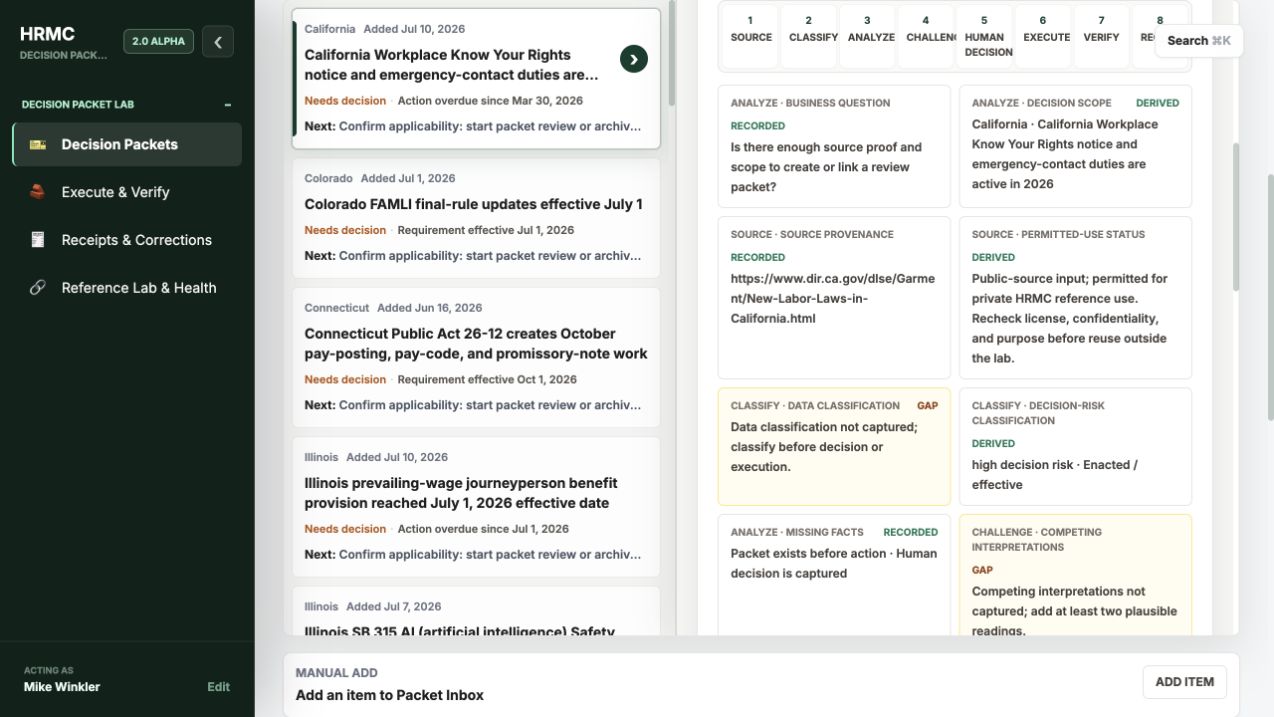
Look closer
Source attached
The source-provenance card keeps the public URL in the packet. A reviewer can open the original instead of relying on the summary alone.
Gaps called out
The yellow card says data classification has not been captured. A second warning flags missing competing interpretations. Both gaps remain visible before a decision or execution.
Person still decides
Human decision is a separate step before Execute and Verify. The packet prepares a review; it does not approve its own conclusion.
The failure that changed the build
A page title changed. HRMC opened a duplicate case.
One test page got a new title. HRMC opened a second case and left the earlier review, owner, and notes on the first one. The screen still looked orderly. The work was now split in two.
I changed how HRMC identifies the underlying issue, so a new page title no longer creates a new case. Comparing titles was the wrong way to remember work a person had already reviewed.
Dated local checks
What the local tests checked
These July 2026 checks used public or made-up data in a limited local test.
July 15, 2026
64/64Repeatable checks passed
The same expected behaviors held across the local test suite.
July 13, 2026
10/10Known items found
The workflow found every item in a small source set I had already checked by hand.
July 10, 2026
240Local requests completed
The prototype completed 240 requests without a failure during a five-minute test.
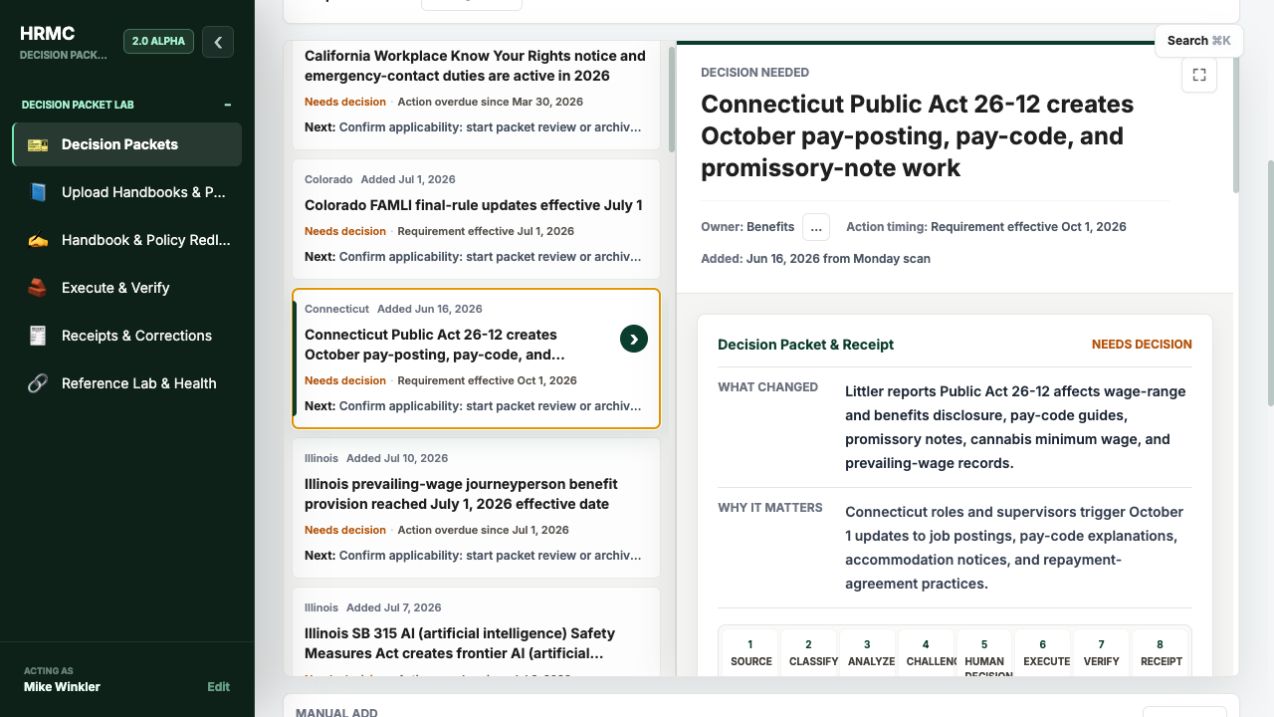
The public trail
Public notes and a community mention
The public workflow library documents the design and its limits. AI for HR Community also described the OpenClaw work in a session announcement.
The boundary
Scope and limits
HRMC prepares and routes work for a qualified person. It does not provide legal advice or interpret company policy. These local tests do not establish complete source coverage, legal correctness, security, production readiness, or client outcomes.
- No employee discipline, termination, pay, promotion, leave, or accommodation decisions
- No production access to company or employee data in this build
- No action past the review gate without explicit approval
What I bring to client work
How this informs an advisory engagement
The duplicate-case bug gave me a specific question to ask in a workflow review: when a source changes, does the earlier human review stay attached? I would want that tested before a team relied on the record.
In an HR process review, I map those dependencies in your process. In an AI pilot review, I examine what happened when the source, reviewer, or next action changed.