I’ve advised executives on their organizations, scaled performance management, developed People Partners, and led compensation and Workday work. These examples come from my employment experience. The AI prototypes are my independent work.
Interactive walkthrough
See where AI helps—and where a person decides.
Walk through a fictional policy clarification. See what AI prepares, what a person checks, and what evidence closes the case. Then explore the system in 3D.
I turned informal headcount decisions into a structured model with Finance. I also rebuilt career ladders and competency frameworks for Operations & Member Experience.
A 500–600-person portfolio across Risk and Operations & Member Experience.
As the HR leader for CB2, I redesigned roles, career paths, and reporting lines for 130 Photo Studio Operations associates. I also built the brand’s first formal store-compensation structure across 21 stores.
Brand-wide HR leadership across stores and corporate operations.
As an HRIS Analyst, I designed Workday business processes and custom reports, contributed to the Workday Learning implementation, and built the reporting foundation used by HR operations.
Workday testing and adoption across stores and corporate
I led user-acceptance testing and change management for a Workday implementation across CB2’s 800-person workforce. I designed adoption workflows and prepared store and corporate leaders for the transition.
I managed and developed a direct report who was promoted to Senior People Partner. I also mentored other People Partners while advising executives across technical and business teams.
People management and coaching alongside my own HRBP portfolio.
I helped build a follow-the-sun cybersecurity operating model with an employer-of-record arrangement in Poland. The work connected international hiring and organization design to the team’s need for 24-hour coverage.
These examples describe my roles with the named employers. They are not advisory-client case studies. Sources are my published LinkedIn experience and résumé.
Independent builds and test records
My own prototypes and documented workflow designs.
Working prototype
HR Mission Control
A prototype that watches a defined set of public sources, collects the relevant details, gives the work an owner, and keeps the decision and follow-through together.
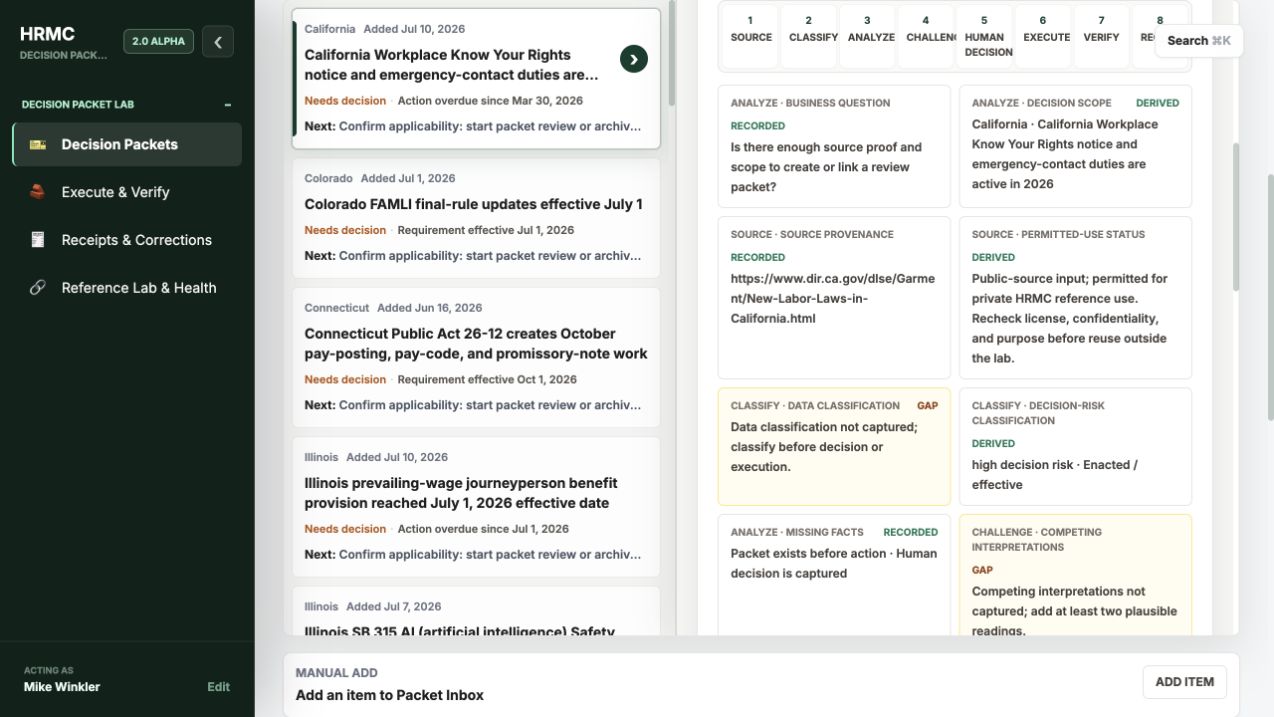
The source-provenance card keeps the public URL in the packet. A reviewer can open the original instead of relying on the summary alone.
2Gaps called out+
The yellow card says data classification has not been captured. A second warning flags missing competing interpretations. Both gaps remain visible before a decision or execution.
3Person still decides+
Human decision is a separate step before Execute and Verify. The packet prepares a review; it does not approve its own conclusion.
Private HRMC prototype, using public-source test material. Yellow cards flag missing information.Open image at full size ↗
Update
Summary
HR review
Owner
Action
Done
What I checked
64 of 64 repeatable checks passed on July 15, 2026
10 of 10 known items found in a small, human-checked source test on July 13, 2026
240 local requests completed without a failure in a five-minute test on July 10, 2026
What it does not do
It helps organize the work. It does not give legal advice, promise complete coverage, or make policy decisions.
A design for answering policy questions from approved material. The proposed workflow would show its sources and refer sensitive questions to the right person.